How to Choose the Right Dog House Size
The best dog house is one your dog can stand in, turn around in and stretch out in.
October 8, 2026 · 3 min read
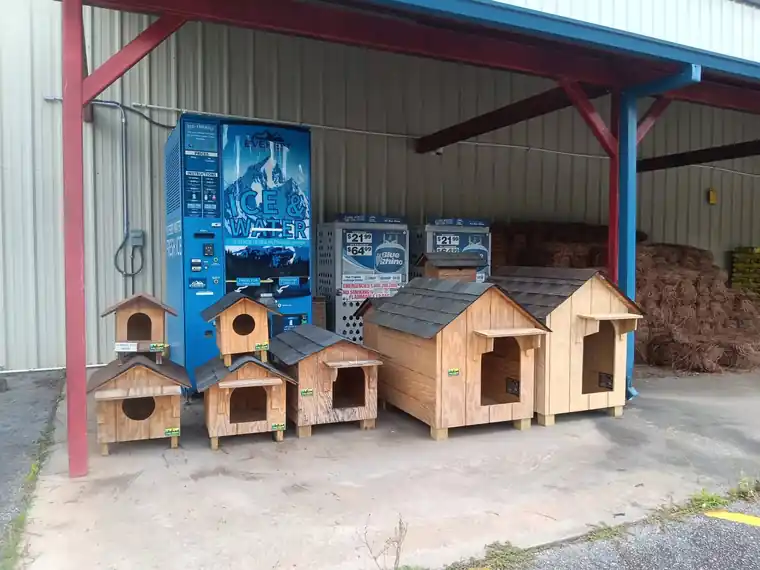
Picking a dog house sounds simple until you're standing in front of a row of them. Small, medium, large, extra large. Which one is right for the dog sitting at your feet looking hopeful? A house that's too small is cramped and uncomfortable, and a dog will avoid it. A house that's too big wastes money and doesn't hold warmth as well as a snug one.
The good news is that you can figure out the right size at home with a tape measure and about ten minutes. Here's how.
Measure your dog first
You need three measurements, and it's easiest with a helper and a few treats. First, length: measure from the tip of the nose to the base of the tail, with your dog standing naturally. Second, height at the shoulder: stand your dog against a wall and measure from the floor to the top of the shoulder blades. Third, overall standing height: measure from the floor to the top of the head, because that's what has to fit through the door and under the roof.
Write the numbers down. When you're talking to a dealer or a builder, they're the most useful thing you can bring.
Room to stand, turn and stretch
Here's a simple test. Your dog should be able to walk in, stand up without bumping its head, turn all the way around, and lie down with legs stretched out. If any of those three is a struggle, go up a size.
Pay attention to how your dog sleeps. Some dogs curl into a tight ball, and some sprawl flat on their side. A sprawler needs real floor length. A curler is happy with less, but still needs headroom to move around, especially in a wet spell when the house is the only dry spot in the yard.
Why bigger isn't always better
It's tempting to buy the biggest house you can afford, just to be safe. Resist that. Extra space means extra air for your dog to heat, and a snug house holds on to a dog's own body warmth better in cool weather. A huge house also leaves a shy dog feeling exposed, when what a dog usually wants from a house is a place that feels like a den.
You want room, not a barn. Aim for a house where your dog fits comfortably with a bit to spare, not one where it looks lost.
Puppies, seniors and the growing question
If you've got a puppy, think about the adult dog it will become. Ask whoever you got the puppy from how big the breed or mix usually gets. Buying one house for the full-grown dog makes more sense than buying two. A puppy will find its way around a larger house just fine, and you can tuck in extra bedding until it grows into the space.
For older dogs, go the other way on the door. Stiff joints make high thresholds hard, so look at a low, wide entry and a floor that sits at an easy step height. A senior dog should be able to walk in rather than climb.
Don't forget the door
The door is the part people forget to measure. It should be tall enough that your dog doesn't have to duck deeply, and wide enough for its shoulders to clear without rubbing. A dog that squeezes through a tight door will start to avoid the house, no matter how nice the inside is.
Door placement matters, too. A door set off to one side, with an awning over it, keeps wind-driven rain from blowing straight onto the bed. That's the design we use on our houses, and it's worth looking for in any house you buy.
Nine sizes, plus custom
Clark's Woodwork builds dog houses in nine sizes, from the 2XS Puppy up to the 4XL Megatron, so there's a fit for almost every dog from a tiny pup to a big, heavy-boned giant. If your dog falls between sizes, or you've got something unusual in mind, we can build custom dimensions on request. Our houses are made with 5/8 inch T1-11 exterior siding, a 3/4 inch Advantex floor with a 50-year manufacturer warranty, and a shingled roof with a 20-year warranty.
Bring your measurements and give us a call at (706) 372-6294, or look for our houses at a dealer near you in Georgia, South Carolina or North Carolina. We'll help you land on the right one.
Clark's Woodwork, (706) 372-6294
Call (706) 372-6294